Leak investigation · Written reports
Balcony water testing and leak reports
Before anyone spends money lifting tiles, a leaking balcony needs one thing settled: where the water is actually getting in. We test the balcony under controlled water, watch the space below while it happens, and give you a written report with photographs showing what we found and what it will take to fix.
This is a paid investigation service, separate from our repair work. Owners corporations, property managers and apartment owners across Melbourne use our reports to settle who is responsible, to support an insurance or defect claim, and to get an accurate scope before anyone quotes a repair.
- Written report with photos
- Certified Kerakoll waterproofing
- Fully insured
in the remedial repair trade
Google rating from 28 reviews
spray testing, dye tracing and thermal imaging
after-hours emergency leak call-outs
What a balcony water test is
A balcony water test is a controlled experiment. Instead of guessing from a stain on a ceiling, we reproduce the leak on purpose, under conditions we can see and control, while someone watches the room, garage or balcony directly below.
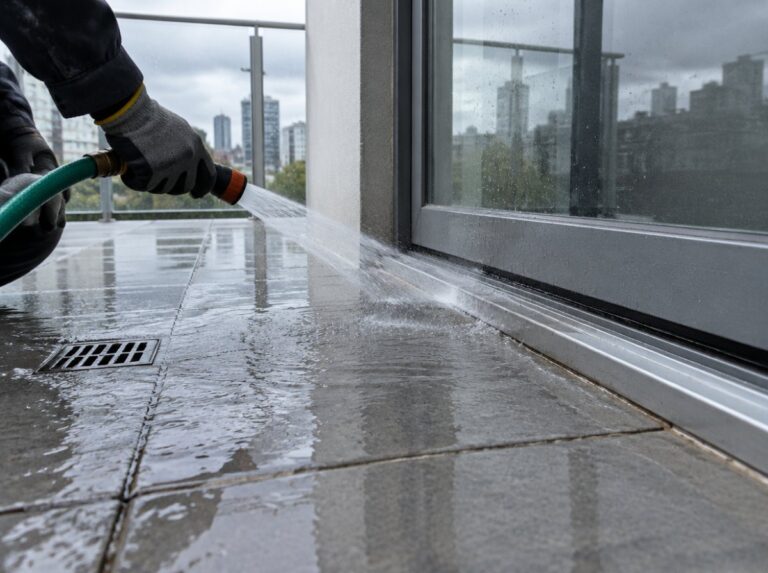
We start water at the lowest point of the balcony and work upwards in stages — the drain and the tile field first, then the grout and movement joints, then the door threshold, then the balustrade fixings and the wall above. Each stage runs long enough to show a result before the next one starts. When water appears below, we know which stage caused it, so we know which detail has failed.
That matters because almost every leaking balcony has several suspects at once, and the obvious one is often not the cause. Water gets in at a cracked movement joint and comes out three metres away through a light fitting. Testing in stages is the only reliable way to separate the detail that is leaking from the details that merely look bad.
Testing is not the same as a free quote
Our repair inspections and quotes are free. A water test is different work: it takes hours on site, it needs two people when there is a lot below, and it produces a written report you can hand to a committee, a manager or an insurer. It is charged as a service in its own right.
How we test
- Staged spray testing Controlled hose testing of one element at a time — drainage, tile field, grout and movement joints, threshold, balustrade fixings, then the wall and windows above. Volume and duration are held steady so the result means something.
- Dye tracing Coloured dye added to the test water so the leak path is confirmed rather than assumed. When dyed water shows up in the ceiling below, the argument about where it came from is over.
- Thermal imaging An infrared camera reads the temperature difference wet material creates, which maps how far water has tracked inside the slab, walls and ceiling — including damage well away from the visible stain.
Testing is non-destructive. Nothing is cut, lifted or drilled unless you ask us to, and if we recommend opening something up to confirm what is under the tiles, we tell you why and quote it separately before anything is touched.
What is in the report
You receive a written report, usually within a few days of the test. It is prepared so that a committee member or a property manager who was not on site can read it and understand exactly what happened.
- The address, date, weather conditions and which balcony was tested
- What we tested, in what order, and for how long
- Photographs of the balcony, the defects found and the water coming through below
- Thermal images showing the extent of moisture behind the surface
- Where the water is entering, in plain language, with the evidence for that conclusion
- What was tested and did not leak — often just as useful
- Our recommended repair, and what happens if it is left
- A written quotation for the permanent repair, if you want one
If the test is inconclusive — and occasionally it is, because some leaks only appear under wind-driven rain from one direction — the report says so, and says what the next step should be. We do not manufacture a conclusion to fill a page.
Who asks for a water test
- Owners corporations and strata managers When a lot owner reports water and the committee has to decide whether it is common property or the owner’s responsibility, a test settles it on evidence instead of opinion, before any money is committed.
- Property managers and landlords A tenant reports a ceiling stain and the cause has to be identified quickly, documented for the owner, and either repaired or referred on.
- Apartment and home owners Water is coming into your unit from the balcony above, or yours is being blamed for a leak below, and you need an independent account of what is actually happening.
Reports are written to be handed on. Insurers, engineers and legal advisers all read them regularly, and the photographs and thermal images do most of the work.
Why testing costs less than guessing
The usual sequence on a leaking balcony is: regrout it, wait, still leaking; reseal the threshold, wait, still leaking; then finally lift the tiles and find that the membrane was never turned up at the door. Each of those rounds costs money, and the water keeps running through the slab the whole time.
A test done properly at the start replaces that sequence with one answer. It also protects you the other way: if the balcony above is not the source at all — and sometimes the water is coming from a failed window seal, a cracked render joint or a plumbing pipe — you find that out before authorising a balcony rebuild that would have changed nothing.
Concrete does not recover on its own either. Water sitting against reinforcement corrodes the steel, the steel expands, and the concrete spalls off the slab edge. What starts as a stain becomes concrete cancer, which costs several times what the waterproofing repair would have.
What it costs
Water testing is quoted as a fixed fee before we start, so there is no open-ended hourly bill. The price depends on how many balconies are being tested, how long each stage needs to run, whether access to the lot below has to be arranged, and how high up the building the balcony sits.
Tell us the address, which balcony and what you are seeing below, and we will come back with a fixed price for the test and the report. If you go ahead with the repair, the report becomes the scope of works, so nothing is inspected twice.
If water is coming in right now and it cannot wait, our after-hours emergency call-out includes a temporary fix, a photo report of where we think the water is coming from and a written quote for the permanent repair.
How it works
- You send us the details The address, which balcony, what you are seeing below, and photos if you have them. Our online form takes photos and video straight from your phone.
- We quote the test A fixed fee for the test and the written report, with what is included set out in writing.
- We arrange access Testing needs the balcony and, where there is one, the space directly below. We coordinate with the manager, the owner or both.
- We test on site Staged spray testing with dye, monitored below, with thermal imaging as the water tracks through. Usually two to four hours for a single balcony.
- You get the report Written up with photographs and thermal images, delivered by email, with a quotation for the repair if you want one.
- We repair it, if you want us to We are a remedial specialist first — we can carry out the balcony waterproofing repair ourselves, with a Kerakoll system warranty.
Related repairs
Once the source is confirmed, the repair usually falls into one of these: balcony waterproofing and restoration, concrete crack and spalling repairs, render crack repairs or cladding repairs.


Frequently asked questions
What is a balcony water test?
It is a controlled test where we deliberately run water over your balcony in stages — drainage first, then the tile field, grout and movement joints, the door threshold, and finally the balustrade fixings and the wall above — while someone watches the space below. Coloured dye in the water confirms the path, and a thermal imaging camera shows how far the moisture has tracked inside the structure. Because only one element is wet at a time, the stage that produces water below tells us exactly which detail has failed.
How long does a balcony water test take?
Allow two to four hours on site for a single balcony. Each stage has to run long enough for water to travel through the build-up and appear below, which is not instant — rushing it is the main reason informal hose tests come back inconclusive. Several balconies in the same building are usually quicker per balcony, because access is already arranged.
Do you have to lift the tiles to find the leak?
No. Water testing, dye tracing and thermal imaging are all non-destructive, and in most cases they identify the entry point without anything being cut or removed. If the results point to a failed membrane under the tiles and you want that confirmed before committing to a full rebuild, we can lift a small area or take a core sample — but only with your approval, and quoted separately.
Will the test make the leak worse or damage the unit below?
The test uses no more water than heavy rain, and it is run in stages under supervision with someone watching below, so it is stopped the moment water appears. We arrange protection for the space underneath before we start. The point is to see a small amount of water in controlled conditions rather than wait for the next storm to deliver a large amount.
What do I get at the end?
A written report, usually within a few days. It sets out the address and date, what was tested and in what order, photographs of the defects and of the water coming through, thermal images showing the extent of the moisture, our conclusion on where the water is entering with the evidence for it, and what we recommend. If you want one, a written quotation for the permanent repair comes with it.
Can I use the report for an insurance claim or an owners corporation dispute?
Yes. Our reports are written to be handed on to a committee, a strata manager, an insurer, an engineer or a legal adviser, and they are regularly used that way. They record what was tested, what happened and what the evidence shows, with dated photographs and thermal images. We are a remedial repair contractor, not a law firm, so we report on the building — the legal conclusions are for your adviser.
Who is responsible for a leaking balcony in an apartment building?
It depends on the plan of subdivision and on where the failure is. In Victoria the structure of the building and common property are generally the owners corporation’s responsibility, while finishes inside a lot are generally the owner’s — but balconies sit right on that boundary, and whether the waterproof membrane is common property varies from building to building. That is why a water test is worth doing early: it establishes on evidence which element failed, so the question can be answered from the plan of subdivision rather than argued about. Check the plan and your owners corporation rules, and take advice if it is contested.
How much does a balcony water test cost?
It is quoted as a fixed fee before we start, not charged by the hour. The price depends on how many balconies are being tested, how long each stage needs to run, whether access to the lot below has to be arranged, and how high the balcony sits in the building. Send us the address and what you are seeing below and we will come back with a fixed price for the test and the report.
Do you carry out the repair as well?
Yes. Melbourne Building Repairs is a remedial specialist — balcony waterproofing, render, concrete and cladding repairs are our core work, and our director is certified in Kerakoll waterproofing systems. If you go ahead with us, the report becomes the scope of works, so the balcony is not inspected twice. You are also free to take the report elsewhere; it is yours.
Balcony leak investigation
Find out where the water is getting in
We carry out balcony water testing and written leak reports for owners corporations, property managers and owners across metropolitan Melbourne. To book a test, call 0468 800 300 or get in touch.